Read your scorecard
Settle the nineteenth-hole argument before it starts: your card shows what you shot, what it earned in points and what it does for your handicap. Here's what every number, colour and star on it means, and which one counts.
1. Find your scorecard
Open the round and choose its Scoring section, then use the picker in the header to choose Scorecards. Yours comes first, then everyone's.
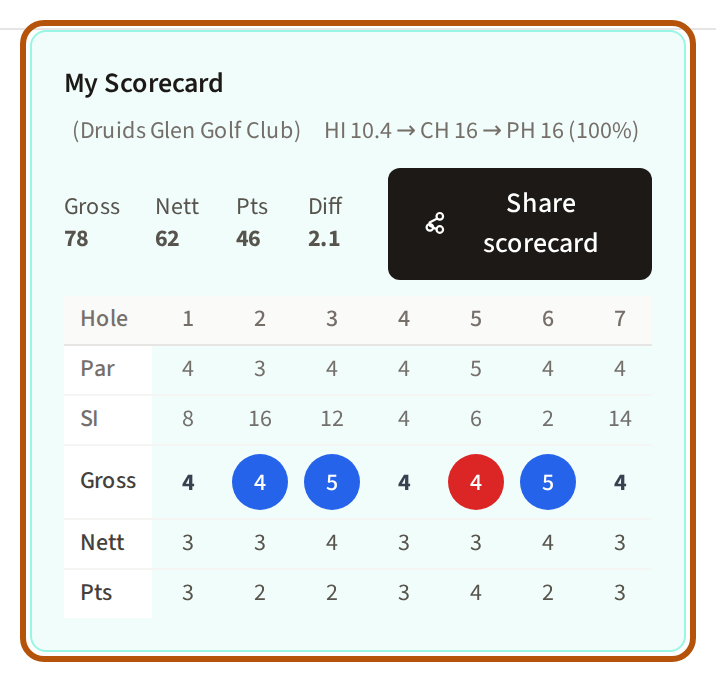
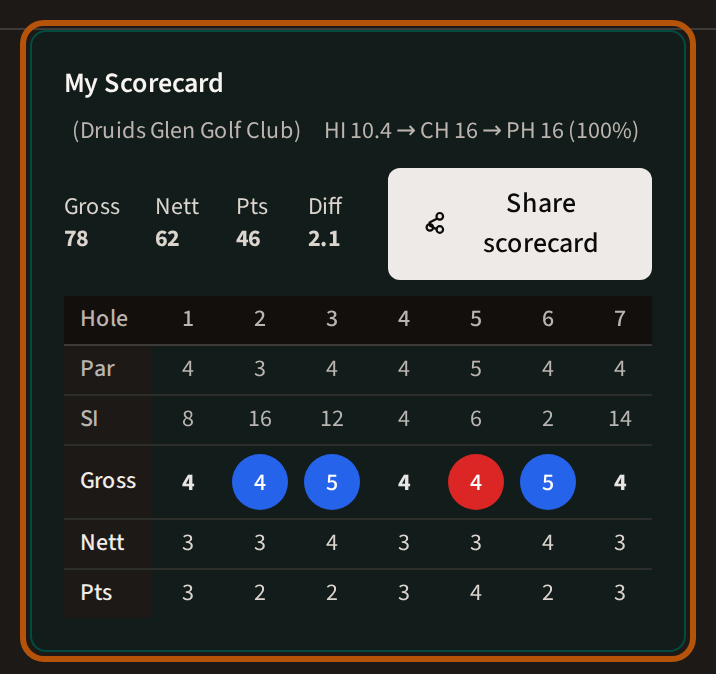
The card slides sideways for the rest of the holes.
2. The four numbers at the top
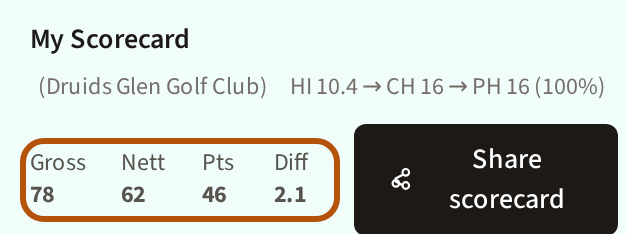
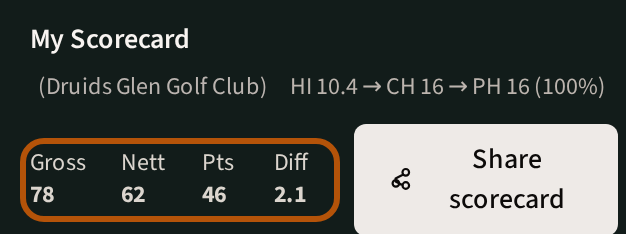
- Gross — the strokes you actually took.
- Nett — your gross less the handicap strokes you get.
- Pts — your Stableford points: 2 for a nett par, 1 for a nett bogey, nothing for worse; 3 for a nett birdie, 4 for a nett eagle, and 5 for a nett albatross or better.
- Diff — your Score Differential: what the round is worth to a handicap, with the course's difficulty taken out. Lower is better.
The line above them shows your handicap for this round in three steps: your Handicap Index (HI), the Course Handicap it gives off these tees (CH), and the Playing Handicap the competition uses (PH).
3. The coloured circles


A gross score in a circle tells you how it went at a glance: red under par, blue over par, darker the further out. A plain number is a par.
4. A hole you picked up
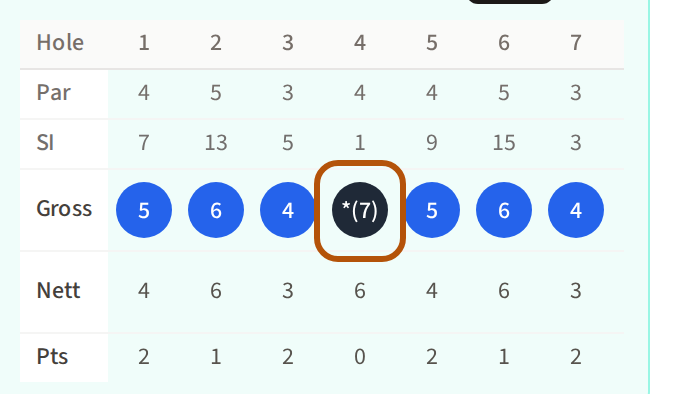
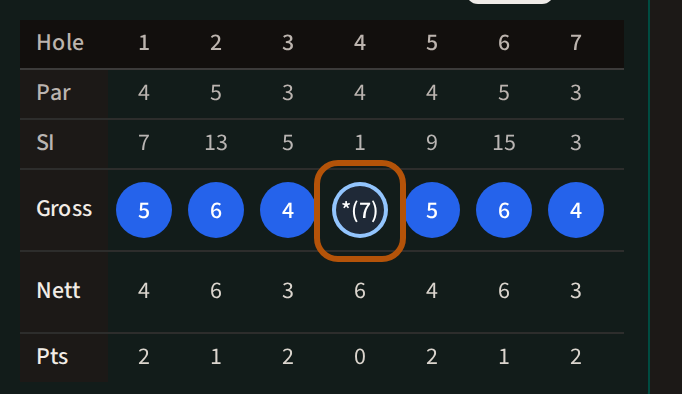
*(7) means you picked up. The star says no score was holed out; the number in brackets is what the hole counts as for your handicap — a nett double bogey: par, plus 2, plus any strokes you get there.


The total follows the same rule. *(95) is your adjusted gross — the figure your handicap uses — and the star says it includes a hole you picked up. A number in brackets anywhere on a card is the score that counts for handicap.
For your handicap, any hole is capped at a nett double bogey, so one disaster cannot wreck your record. In a Stableford competition a picked-up hole simply scores no points.
NP is different: the hole was not played at all. It scores nothing on points, puts the card down as DNF on a Gross or Nett competition, and the round won't count for your handicap. Whoever marks the card chooses between the two — see Score a round.
5. If the organiser ruled your card
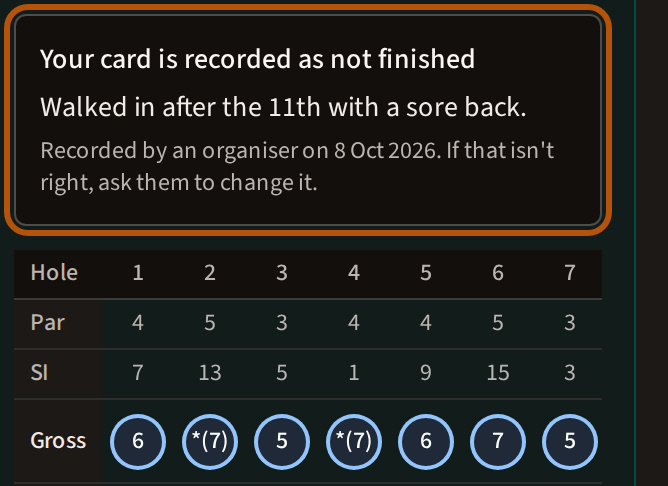
When the organiser completes the event, they can rule that a card did not finish (DNF), or that a player did not play. A ruled card says so in a box directly above its holes: Your card is recorded as not finished for a DNF, or Your card has a ruling recorded for any other ruling. Under it is the organiser's reason, then Recorded by an organiser with the date — and, on your own card, If that isn't right, ask them to change it. On another player's card the box names them in place of Your card.
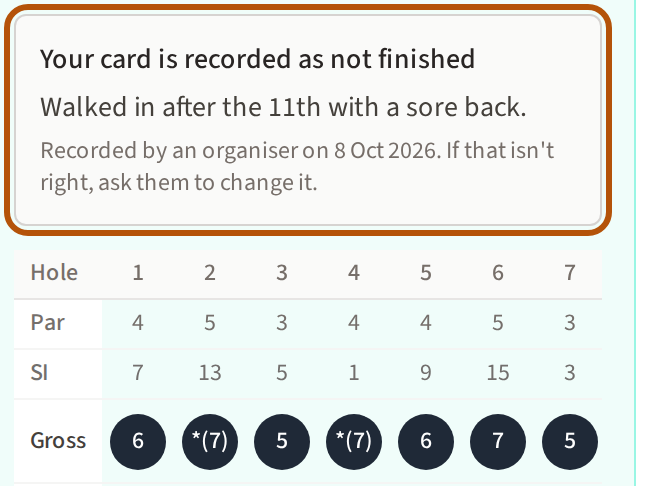
On the Leaderboard a card ruled DNF reads DNF in place of its score, and a player ruled Did not play reads DNP in place of a position — see Read the leaderboard.
Which number counts?
Your competition result uses nett or points, depending on the competition. Your handicap uses the adjusted gross and the Score Differential worked out from it — and only from a round that counts for handicap: a singles stroke play or Stableford competition, with at least 14 holes scored and none marked NP, once the event is completed. A match play round still shows its Diff, but it does not count.
Still stuck? Tell us and we will help.